For the founder the whole company waits on
Everything in your company still waits on you. It isn't your team.Read the free chapter that shows you the survival pattern running your business, and why the next milestone won't switch it off.
Sunday, around seven, Monday starts in your head. At your kid's game you check your phone between plays. Your leadership team brings you decisions they're paid to make, and you make them. And somewhere there's a number, the next milestone or the exit, where it's all finally supposed to feel okay.
You've hit numbers before. The feeling lasted about as long as the drive home.
That isn't a time-management problem, and another system won't touch it. The traits that built your company started out as ways to survive something, long before the company existed. They still run the show. Chapter 1 shows you which one is running you.
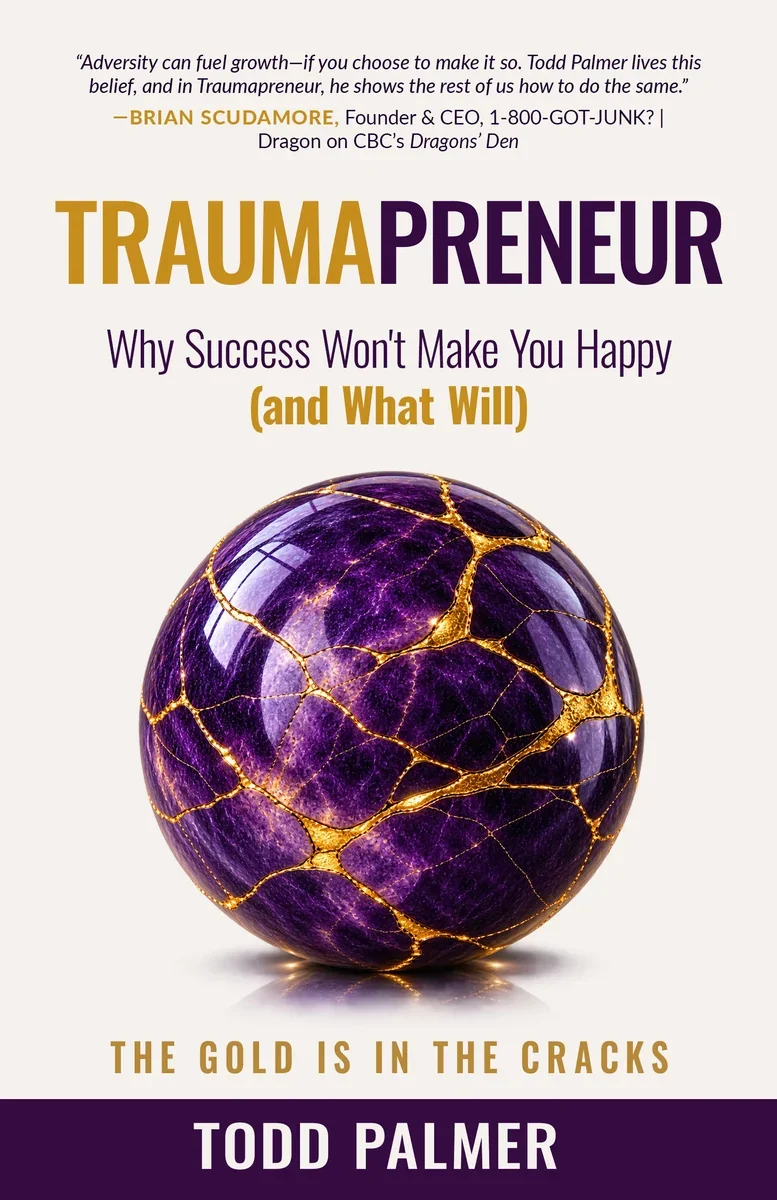 Free chapter
Find the pattern that's running you
Get the Introduction and Chapter 1 free. It opens the moment you sign up.
Be honest. How many of these happened this month?
You built the company so you'd have freedom. Look where it put you.
- A "quick check-in" on vacation that ate the whole afternoon, on a problem your team could have handled.
- Your kid scored, and you looked up a second late because you were reading an email.
- A meeting where four smart people waited for you to say what they already knew.
- Lying awake at 2 a.m. running the cash, the client, the hire, again, even though nothing changed since 10 p.m.
- A win you'd chased for a year. You felt it for an afternoon. By Monday you'd moved the target.
- Your spouse asking, "Where are you?" while you were sitting right there.
If you checked even two, you're not lazy about delegating and you're not bad at boundaries. You're running a pattern, and you can't fix what you can't see.
What it costs if nothing changes
The bill doesn't show up on the P&L. Until it does.
- The business stops at your ceiling. When every decision runs through one inbox, the company can only grow as fast as you can think. In Chapter 1 a founder's growth flatlined for exactly this reason: everything bottlenecked at her desk.
- Home gets what's left. Your family gets the version of you that's still half at the office. They feel the cost of your patterns before you do.
- Your body keeps score. Running on vigilance for years isn't free. As the Introduction puts it: "Eventually, something breaks—the business, the body, the marriage, or the mind."
- The next milestone won't help. You already know this. You hit the last one.
You can't solve an internal problem with external success.
Todd Palmer, Traumapreneur
The big idea
Your best traits are survival patterns. They're still running your company.
The vigilance that spots a problem three moves early. The self-reliance that got you through the year nobody believed in you. The standards nobody else can hit. You didn't pick those up in business school. You built them as a kid to stay safe, and they worked so well you built a company on them.
Here's the catch: they don't know you're safe now. Chapter 1 explains why your threat-detection system runs "automatically, constantly, at enormous energetic cost," and why so many founders are exhausted even when the business is thriving.
So what you call "attention to detail" is often hypervigilance. What you call "hustle" is often workaholism. What you call "high standards" is often difficulty trusting anyone else. Your team doesn't experience your standards. They experience the pattern underneath them.
You don't have to lose your drive. You need to see what's driving it. That's what the free chapter does.

Why Todd wrote it
Profitable in 72 days. $600,000 in debt nine years later.
In 1997, at twenty-nine, Todd Palmer started Diversified Industrial Staffing with a business plan and $15,000 from a friend. Within seventy-two days it was profitable. By 2006 it was $600,000 in debt, Detroit was sliding toward the recession, and he was, in his words, "failing spectacularly."
The cause wasn't the market. When Todd was five, his father died of a heart attack. Within ninety days his whole family had scattered. A five-year-old drew one conclusion, and it became the operating system for every business decision he made for the next four decades: "The only person I can truly rely on is me."
That sentence built the company. It also made him resist delegation, resist advice, and micromanage the people who could have saved it. Once he saw it, he rebuilt the company into a six-time Inc. 5000 honoree. The free chapter tells that story, starting on page xi.
Todd is now a Detroit executive coach, Forum retreat facilitator, and Vistage speaker, and the author of From Suck to Success and The Job Search Process.
Inside the free chapter
Twenty-seven pages. Here's some of what you'll find.
- The sentence a grieving five-year-old decided on that later built Todd's company, then drove it to $600,000 in debt. pp. xi–xii
- Why the founder who pitches investors with total confidence may be having an anxiety attack in the bathroom five minutes later, and why nobody on the outside ever knows. p. ix
- The three disguises. What founders call "attention to detail," "hustle," and "high standards," and what's usually underneath each one. p. xiii
- "Your five-year-old's fear of abandonment is choosing which partnerships to pursue." What it means to make million-dollar decisions with emotional data from decades ago. pp. xiv–xv
- "Emily, I am not you!" The line a team member finally said out loud that showed a founder why her speed was creating chaos and why her growth had stalled at her desk. p. 4
- What happened when Emily finally let go. It wasn't relief. It was the question she couldn't answer: "Who was I if they didn't need me?" p. 5
- "Other people had it worse." Why this is one of the most common ways successful founders keep their own pattern hidden from themselves. p. 6
- Why you're tired even when the business is thriving. The threat-detection system that made you great at reading a room, and what it costs to leave it running. p. 8
- The Two-Timeline Exercise. Two lines on one sheet of paper that show where your childhood and your business decisions match. p. 11
- The question most founders don't want to answer: "Is your self-worth tightly connected to your business performance?" It opens the Entrepreneurial Trauma Inventory. p. xx
Plus a map of the HEAL framework (Hurt, Explore, Adapt, Lead), the path the rest of the book walks you through (p. xvii). This is pattern recognition, not a diagnosis, and not a substitute for therapy. You don't need a dramatic story to find yourself in it.
Your move
You can keep calling it a people problem. Or you can read 27 pages tonight.
There's nothing to buy and nothing to admit to anyone. Read the Introduction and Chapter 1. Draw the two timelines. If you see yourself there, you'll know what to do next. If you don't, you've lost an evening.
"Adversity can fuel growth—if you choose to make it so. Todd Palmer lives this belief, and in Traumapreneur, he shows the rest of us how to do the same."
Find the pattern that's running you
The Introduction and Chapter 1, free. It opens the moment you sign up.
P.S. If you only read one page, make it page xi. That's where Todd shows how one decision a five-year-old made after his father died ran his company for decades and nearly bankrupted it. Then turn to page 11 and draw your own two timelines. It may be the first time you see your childhood and your business on the same sheet of paper. It won't be comfortable. It will be clear.